

Aftertaste Masking Agents Market Forecast 2026–2036: Market Size, Share, Competitive Landscape & Future Growth Outlook
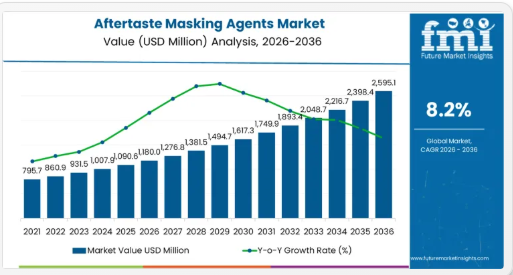
Aftertaste Masking Agents Market projected to reach USD 2,595.1 million by 2036 amid global reformulation trends
NEWARK, DE, UNITED STATES, January 16, 2026 /EINPresswire.com/ -- The global aftertaste masking agents market is entering a period of accelerated growth as manufacturers across food, beverage, pharmaceutical, and nutraceutical sectors respond to rising formulation complexity and evolving consumer expectations around taste, health, and transparency.
Market analysis indicates that the industry is expected to expand from USD 1,180.0 million in 2026 to USD 2,595.1 million by 2036, reflecting a compound annual growth rate (CAGR) of 8.2% over the forecast period. This growth is closely linked to the widespread adoption of high-intensity sweeteners, plant-based proteins, botanical extracts, and functional actives that often introduce bitterness or lingering aftertaste.
Market Context: Reformulation Meets Sensory Performance
Product reformulation initiatives aimed at reducing added sugars, improving nutritional profiles, and aligning with clean-label standards have intensified across global consumer goods markets. While these strategies support public health goals and consumer demand, they frequently compromise taste quality—particularly in beverages, supplements, and medicinal products where palatability plays a decisive role in repeat consumption.
Aftertaste masking agents address these challenges by selectively suppressing undesirable flavor notes without increasing sweetness or altering primary taste profiles. As a result, they have become essential formulation components rather than optional flavor enhancements, especially in products positioned around wellness, functionality, and reduced sugar content.
Product Segmentation Highlights
By Product Type
• Flavor masking agents account for approximately 42% of total market demand, reflecting their broad utility in managing off-notes from sweeteners, vitamins, and plant-based ingredients.
• Bitter blockers represent 31%, with growing relevance in products containing alkaloids, amino acids, and pharmaceutical actives.
• Sweetness enhancers and other masking solutions make up the remaining share, supporting taste balance and sensory optimization.
By Application
• Beverages lead market adoption with roughly 36% share, driven by low-sugar soft drinks, functional waters, sports nutrition beverages, and flavored dairy alternatives.
• Pharmaceuticals hold 24%, where improved taste is directly linked to patient compliance.
• Dietary supplements account for 18%, particularly in chewables, powders, and liquid formulations.
• Processed foods and other applications complete the market landscape.
By Form
• Liquid masking agents dominate with 49% share, favored for ease of blending and rapid sensory impact.
• Powder formats represent 37%, commonly used in dry mixes and encapsulated products.
• Granular forms account for 14%, addressing specialized manufacturing requirements.
Regional Outlook: Emerging and Established Markets
Growth dynamics vary by region, with emerging economies showing faster adoption rates due to expanding functional food and beverage categories, urbanization, and rising disposable incomes. India and China are projected to experience the strongest growth, supported by nutraceutical innovation and sugar-reduction initiatives. Brazil is also gaining momentum as beverage and supplement portfolios diversify.
In mature markets such as the United States and the United Kingdom, demand is driven by regulatory scrutiny on added sugars, heightened clean-label awareness, and continued investment in formulation science to preserve taste quality amid nutritional reformulation.
Competitive Landscape and Industry Relevance
The competitive environment is characterized by global flavor and ingredient companies offering integrated masking platforms that combine sensory science, application expertise, and regulatory compliance. Market participants are prioritizing solutions that deliver consistent performance across multiple matrices while meeting clean-label, allergen-free, and sustainability expectations.
Key differentiators include masking efficiency at low inclusion rates, stability under varied processing conditions, and customization for region-specific taste preferences. Collaboration between ingredient suppliers and product developers is increasingly shaping innovation pipelines.
Forward-Looking Perspective
As consumer expectations for healthier products continue to rise, aftertaste masking agents are expected to play a central role in enabling innovation without compromising sensory appeal. The convergence of sugar reduction policies, functional ingredient adoption, and global wellness trends positions the market for sustained, long-term growth through 2036.
To access the complete data tables and in-depth insights, request a sample report here: https://www.futuremarketinsights.com/reports/sample/rep-gb-31436
Explore More Related Studies Published by FMI Research:
Cooking Coconut Milk Market https://www.futuremarketinsights.com/reports/cooking-coconut-milk-market
Specialized Nutrition Market https://www.futuremarketinsights.com/reports/specialized-nutrition-market
Hemp Protein Powder Market https://www.futuremarketinsights.com/reports/hemp-protein-powder-market
About Future Market Insights (FMI)
Future Market Insights, Inc. (FMI) is an ESOMAR-certified, ISO 9001:2015 market research and consulting organization, trusted by Fortune 500 clients and global enterprises. With operations in the U.S., UK, India, and Dubai, FMI provides data-backed insights and strategic intelligence across 30+ industries and 1200 markets worldwide.
Why FMI: https://www.futuremarketinsights.com/why-fmi
Sudip Saha
Future Market Insights Inc.
+1 347-918-3531
rahul.singh@futuremarketinsights.com
Legal Disclaimer:
EIN Presswire provides this news content "as is" without warranty of any kind. We do not accept any responsibility or liability for the accuracy, content, images, videos, licenses, completeness, legality, or reliability of the information contained in this article. If you have any complaints or copyright issues related to this article, kindly contact the author above.
