

Egg Replacers Market to Reach USD 4.18 Billion by 2035 on Rising Clean-Label and Protein Innovation
Egg Replacers Market
Egg replacer demand rises as egg-price volatility, plant-based diets, and precision fermentation reshape global food formulation.
The Egg Replacers Market is being reshaped by a clear convergence of supply-chain resilience, consumer demand for plant-based choices, and ingredient innovation,”
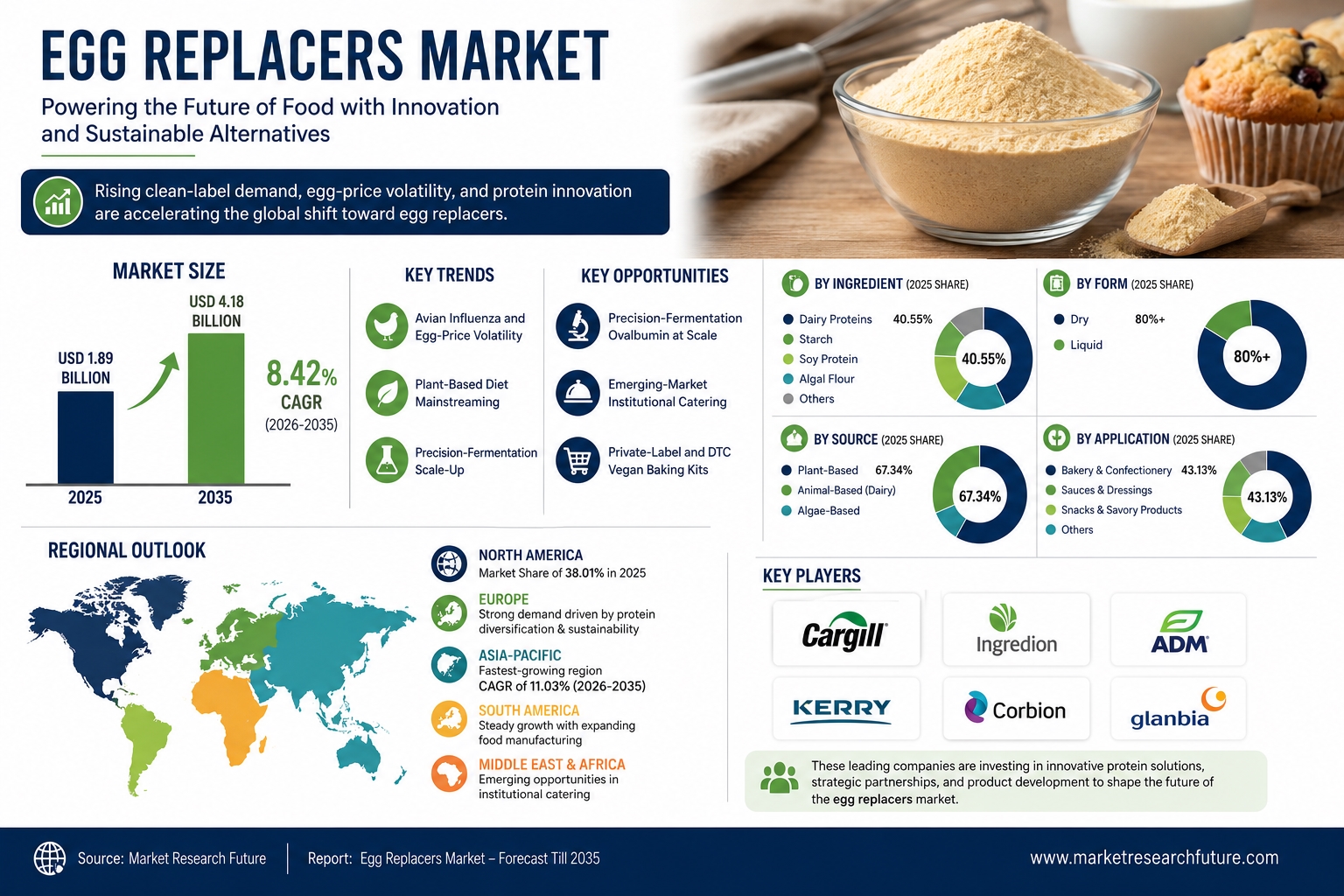
NEW YORK, NY, UNITED STATES, July 16, 2026 /EINPresswire.com/ -- The global Egg Replacers Market is entering a strong growth phase, supported by rising demand for clean-label formulations, expanding plant-based eating habits, and ongoing disruptions in conventional egg supply. According to Market Research Future, the market stood at USD 1.89 billion in 2025 and is projected to reach USD 4.18 billion by 2035, advancing at a CAGR of 8.42% during the forecast period from 2026 to 2035.— Market Research Future (MRFR)
Market Momentum Accelerates Across Food Manufacturing
The market’s momentum is being reinforced by recurring avian influenza outbreaks, persistent egg-price volatility, and the increasing willingness of manufacturers to reformulate products with reliable, scalable alternatives. Food producers are moving beyond traditional starch-and-lecithin systems and are now investing in more advanced ingredient platforms, including precision-fermentation proteins, aquafaba-based solutions, flax-based substitutes, soy protein blends, and algae-derived ingredients that better replicate the binding, foaming, and emulsifying functions of shell eggs.
Egg replacers have evolved from a niche bakery ingredient into a strategic formulation category across industrial food manufacturing. Their use is expanding in bakery and confectionery, sauces and dressings, snacks and savory products, and other processed food applications where egg functionality is important but supply stability, allergen management, cost control, or label transparency is a priority. Market Research Future notes that bakery and confectionery accounted for 43.13% of revenue in 2025, while sauces and dressings are among the fastest-growing application areas through 2035.
Avian Influenza and Price Volatility Reshape Procurement
Avian influenza and egg-price volatility remain among the most immediate market catalysts. Market Research Future reports that recurring outbreaks and tighter biosecurity measures across the US and EU have pushed food manufacturers to secure multi-year supply arrangements and accelerate the use of plant protein egg alternative ingredients. The report also highlights that government and industry attention is intensifying around diversified protein supply chains, reinforcing the case for alternative ingredient systems that can reduce dependence on conventional shell eggs.
For manufacturers, the issue is no longer limited to temporary shortages. Egg supply disruptions have become a recurring planning risk that affects product consistency, margin stability, and procurement strategy. As a result, food companies are increasingly evaluating egg replacers not only for cost savings, but also for business continuity. This shift is especially important for large-scale bakery producers, condiment manufacturers, and snack brands that require predictable ingredient performance across multiple production cycles.
Get Full PDF Sample Copy of Report: (Including Full TOC, List of Tables & Figures, Chart) @ https://www.marketresearchfuture.com/sample_request/2974
Consumer Preferences Drive Reformulation
At the same time, consumer behavior is changing the economics of reformulation. Plant-based diets are no longer a niche movement, and clean-label expectations continue to rise across food categories. As consumers become more aware of ingredient sourcing, allergen management, and sustainability claims, manufacturers are responding with egg replacement solutions that support vegan, allergen-free, and reduced-animal-input product positioning. In the report, plant-based inputs held 67.34% of the market in 2025, underscoring how strongly plant-derived systems continue to dominate commercial adoption.
This consumer shift is particularly visible in premium bakery, frozen desserts, ready-to-eat meals, and packaged sauces, where shoppers increasingly expect ingredient lists that are shorter, more recognizable, and aligned with ethical or dietary preferences. Egg replacers help brands meet these expectations while preserving texture, structure, and shelf appeal. In many cases, they also support product claims such as cholesterol-free, dairy-free, vegan, and non-GMO, which can strengthen shelf differentiation in crowded retail environments.
Precision Fermentation Brings a New Functional Era
Technology is also redefining the competitive landscape. Precision fermentation is moving egg replacement from simple substitution toward true functional equivalence, opening the door to ingredients that can closely mimic the performance of shell eggs in whipped, baked, and emulsified applications. Market Research Future identifies precision-fermentation scale-up as one of the market’s principal trends and points to precision-fermentation ovalbumin as a significant opportunity area over the forecast period. The report further notes that algae-based sources are expected to expand rapidly, reflecting growing demand for allergen-free and clean-label egg replacement solutions.
This technological evolution is important because many food manufacturers have historically faced trade-offs between functionality and label appeal. Precision-fermented proteins may help close that gap by delivering better aeration, binding, and emulsification performance without relying on conventional egg inputs. As production scales and costs improve, these ingredients could become especially attractive for industrial bakeries, premium sauces, and foodservice applications where performance consistency is critical.
Ingredient Insights: Dairy Proteins Lead, Algae Gains Attention
By ingredient, the market remains led by dairy proteins, which captured 40.55% of share in 2025 due to their strong whipping and gelling functionality in commercial bakery lines. Starch-based systems continue to play an important role where cost-effective binding is needed, while soy protein remains a widely used and functional base in many egg replacement formulations. Algal flour is emerging as a particularly attractive ingredient category, supported by consumer interest in novel, plant-forward, and allergen-conscious formulations.
The ingredient landscape reflects a market that is both mature and rapidly innovating. Traditional systems remain relevant because they are affordable, familiar, and easy to integrate into existing production lines. However, newer ingredient classes are gaining traction as manufacturers seek better sensory performance and stronger sustainability narratives. Algae-based and fermentation-derived ingredients are especially compelling because they can support next-generation product development while addressing allergen concerns and supply-chain resilience.
Dry Formats Dominate, Liquid Solutions Gain Speed
By form, dry egg replacers accounted for more than 80% of the market size in 2025, reflecting their shelf stability, transport efficiency, and suitability for industrial manufacturing. Liquid formats, however, are gaining ground and are projected to grow at 11.82% CAGR through 2035, driven by demand for ready-to-use solutions in vegan baking, foodservice, and convenience-oriented food production. This shift suggests that manufacturers are increasingly balancing scale efficiency with ease of use and on-site functionality.
Dry formats remain the preferred choice for large-scale processors because they are easier to store, ship, and dose in automated production environments. Liquid formats, meanwhile, are becoming more attractive in foodservice and artisanal baking, where convenience and immediate functionality matter more than long shelf life. The growing popularity of liquid egg replacers also reflects broader demand for simplified kitchen workflows and faster product preparation in commercial settings.
Regional Outlook: North America Leads, Asia-Pacific Surges
Regional demand is also becoming more diversified. North America held approximately 38.01% of global revenue in 2025, supported by active clean-label reformulation among major consumer packaged goods brands. Europe remained the second-largest market, with demand strengthened by protein diversification goals and sustainability-focused product development. Asia-Pacific is forecast to be the fastest-growing region through 2035, with a CAGR of 11.03%, supported by rising vegan baking demand, growing institutional catering reformulation, and broader adoption of plant protein egg alternatives across food manufacturing.
North America continues to benefit from strong innovation pipelines, established ingredient suppliers, and high consumer awareness of plant-based products. Europe’s growth is being supported by sustainability regulations, protein transition initiatives, and a mature market for vegan and allergen-friendly foods. Asia-Pacific, however, is emerging as the most dynamic opportunity zone, as food manufacturers in countries such as China, India, Japan, and Australia expand their use of alternative proteins in bakery, snacks, and prepared foods.
High-Value Opportunities Emerge Across Channels
The report identifies several high-value growth opportunities that could accelerate adoption over the coming decade. Precision-fermentation ovalbumin at scale is expected to unlock new commercial possibilities in institutional foodservice and industrial processing. Emerging-market institutional catering presents another meaningful pathway, especially where large-scale meal programs are seeking cost-effective, consistent, and allergen-aware ingredient systems. Private-label and direct-to-consumer vegan baking kits are also becoming a visible opportunity, reflecting the growing consumer appetite for at-home cooking solutions that combine convenience, recipe support, and plant-based credibility.
These opportunities are especially relevant as food brands look for ways to diversify revenue streams. Institutional catering can provide high-volume demand, while private-label and direct-to-consumer channels allow brands to test consumer acceptance and build loyalty around plant-based innovation. Together, these channels are helping egg replacers move beyond industrial ingredient use and into broader consumer-facing product ecosystems.
Application Expansion Broadens the Market Base
Commercial egg replacer formulation is no longer limited to one category of customer. It now spans industrial bakeries, condiment manufacturers, savory snack producers, foodservice operators, and consumer brands seeking differentiation in a highly competitive market. In sauces and dressings, for example, egg-free emulsification systems are increasingly relevant for products such as mayonnaise and aioli, where functionality and label-friendly positioning must coexist. This broadening use case is one reason the market is expected to more than double by 2035.
The expansion across applications is also helping reduce dependence on any single end market. Bakery remains the largest segment, but sauces, dressings, snacks, and savory products are becoming increasingly important as manufacturers search for versatile ingredients that can perform across multiple formulations. This diversification strengthens the long-term outlook for suppliers and creates more room for innovation in texture, stability, and sensory performance.
Competitive Landscape Remains Highly Strategic
The competitive landscape includes major ingredient and food-technology companies such as Cargill Inc., Ingredion Inc., Archer Daniels Midland, Kerry Group, Corbion NV, and Glanbia plc. Their participation underscores the strategic importance of egg replacement technologies in the broader ingredients industry, where scale, formulation expertise, and distribution capability are critical to commercial success.
These companies are investing in research, application support, and product development to help food manufacturers transition away from conventional eggs without sacrificing quality. Their involvement also signals that egg replacers are no longer a fringe category. Instead, they are becoming a core part of the global ingredients innovation agenda, with implications for bakery systems, protein diversification, and sustainable food manufacturing.
Challenges Remain, But the Outlook Is Strong
Market Research Future’s report also highlights structural barriers that remain relevant for suppliers and manufacturers. These include functional performance gaps versus shell eggs, pricing premiums in certain markets, consumer texture skepticism, and evolving regulatory frameworks for novel proteins. Even so, the long-term outlook remains positive as improvements in biofunctional performance, lower-cost production methods, and clearer labeling requirements continue to support wider adoption across both developed and emerging markets.
Manufacturers still need to overcome formulation complexity, especially in products where eggs contribute multiple functions at once. However, ongoing advances in ingredient science are steadily narrowing these gaps. As performance improves and production scales, egg replacers are likely to become more cost-competitive and more widely accepted by both industrial buyers and end consumers.
Future Outlook: From Substitute to Strategic Ingredient
As food manufacturers continue to adapt to changing sourcing realities and consumer expectations, egg replacers are set to move further into the mainstream of global formulation strategy. The combination of supply-chain resilience, plant-based demand, and next-generation ingredient science is creating a more durable growth runway for the sector, with the market projected to rise from USD 1.89 billion in 2025 to USD 4.18 billion by 2035.
For brands, manufacturers, and food innovators, the message is clear: egg replacers are no longer only a backup ingredient. They are becoming a core component of product development strategies designed for performance, flexibility, and future-ready food systems. As precision fermentation, algae-based ingredients, and plant protein platforms continue to mature, the market is likely to see broader adoption across bakery, sauces, savory products, and institutional foodservice worldwide.
Discover Related Research Reports By Market Research Future:
Dairy Protein Ingredients Market
https://www.marketresearchfuture.com/reports/dairy-protein-ingredients-market-27123
Quinoa Flour Market
https://www.marketresearchfuture.com/reports/quinoa-flour-market-7386
Plant-based Dairy Market
https://www.marketresearchfuture.com/reports/plant-based-dairy-market-22654
Sagar Kadam
Market Research Future
+1 628-258-0071
email us here
Legal Disclaimer:
EIN Presswire provides this news content "as is" without warranty of any kind. We do not accept any responsibility or liability for the accuracy, content, images, videos, licenses, completeness, legality, or reliability of the information contained in this article. If you have any complaints or copyright issues related to this article, kindly contact the author above.
