

Potato Chips Market Poised for Expansion as Global Value Rises to USD 113.02 Billion by 2035
Potato Chips Market
India's food-processing growth, potato-variety innovation and changing snack habits are creating new opportunities for manufacturers worldwide.
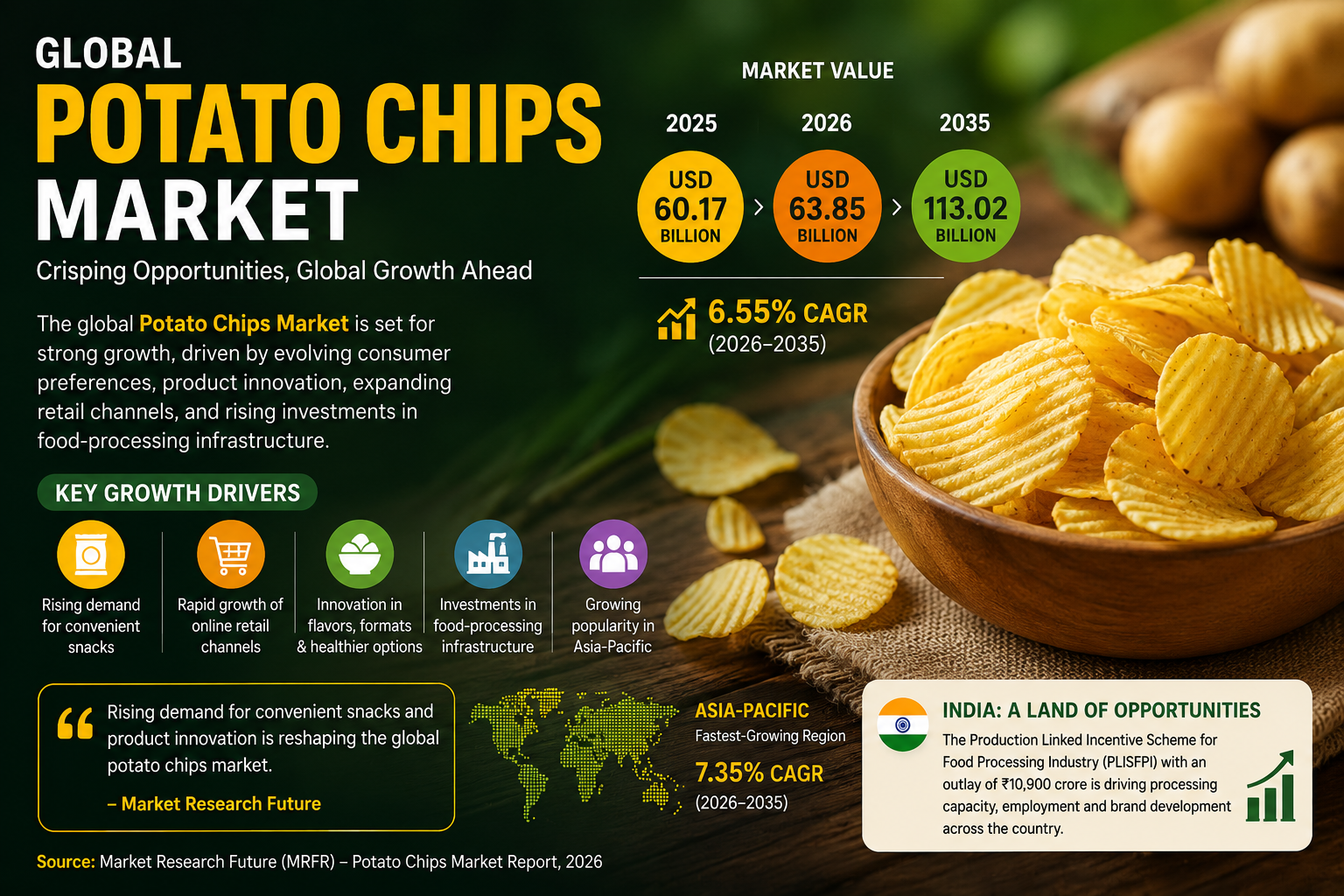
Rising demand for convenient snacks and product innovation is reshaping the global potato chips market.”
NEW YORK, NY, UNITED STATES, August 27, 2026 /EINPresswire.com/ -- The global Potato Chips Market is entering a sustained period of expansion, with market value projected to increase from USD 60.17 billion in 2025 to USD 63.85 billion in 2026, before reaching approximately USD 113.02 billion by 2035, according to Market Research Future. The market is expected to register a 6.55% compound annual growth rate (CAGR) between 2026 and 2035, reflecting continued consumer demand for convenient snacks, premium products, new flavors and increasingly accessible retail channels.— Market Research Future (MRFR)
The growth of the potato chips industry is increasingly being shaped by more than traditional snack consumption. Product innovation, changing lifestyles, expanding modern retail, e-commerce penetration, investments in food-processing infrastructure and the development of potato varieties suited to commercial processing are collectively influencing how manufacturers compete across global markets.
Potato chips remain one of the world's most recognizable packaged snack categories because they combine convenience, portability, affordability and broad flavor appeal. Yet the category is evolving rapidly. Consumers are showing greater interest in baked alternatives, premium and kettle-style products, regional flavors, reduced-sodium formulations and differentiated ingredient profiles, while manufacturers are investing in production efficiency, packaging performance, supply-chain resilience and digital distribution.
Market Growth Supported by Changing Snacking Habits
Convenience continues to be a fundamental driver of the potato chips market. Urbanization, busier lifestyles and the growth of on-the-go consumption have strengthened demand for ready-to-eat snack formats. Potato chips are positioned particularly well within this environment because they require no preparation and are available across supermarkets, convenience stores, foodservice outlets and increasingly through online retail platforms.
The category is also benefiting from premiumization. Consumers are willing to explore products positioned around distinctive potato varieties, kettle cooking, specialty seasonings, regional recipes and more sophisticated packaging. This is giving manufacturers opportunities to increase average selling prices while creating greater differentiation beyond traditional plain or salted products.
At the same time, value-conscious consumers continue to support mainstream and private-label products. This creates a two-track market in which premium products compete through innovation and brand positioning while conventional products compete through affordability, accessibility and high-volume distribution.
The changing role of snacks in daily routines is reinforcing this trend. Potato chips are no longer consumed only during social gatherings or as an accompaniment to meals. They are increasingly purchased for work breaks, travel, school lunches, home entertainment and informal occasions. Smaller single-serve packs support portion control and portability, while larger family packs remain popular for sharing and household consumption.
Manufacturers are responding by offering a wider range of pack sizes and price points. This approach allows brands to serve multiple consumer occasions while improving visibility across different retail environments. It also helps companies manage the tension between premium positioning and affordability, particularly when inflation and household budget pressures influence purchasing decisions.
Get Full PDF Sample Copy of Report: (Including Full TOC, List of Tables & Figures, Chart) @ https://www.marketresearchfuture.com/sample_request/2991
India Emerges as an Important Food-Processing Opportunity
India is becoming increasingly important to the broader food-processing ecosystem. Government policy has encouraged investment in manufacturing capacity, value addition and food-product brands through the Production Linked Incentive Scheme for Food Processing Industry (PLISFPI).
The Government of India established PLISFPI with a total outlay of ₹10,900 crore, supporting food manufacturing, capacity expansion, brand development and employment generation. By February 2026, official figures indicated that 165 applications covering 274 project locations had been approved, while beneficiaries had received ₹2,162.55 crore in incentives. The program had also been associated with approximately 3.39 lakh jobs and an increase of 34 lakh metric tonnes per year in food-processing and preservation capacity.
For potato processors and snack manufacturers, the broader expansion of India's food-processing infrastructure can create opportunities across procurement, processing, packaging, logistics and distribution. Increased processing capacity can also strengthen connections between agricultural producers and branded food manufacturers, supporting greater value addition closer to production centers.
India's large consumer base adds another dimension. As organized retail and digital commerce continue to develop, snack brands have more opportunities to reach consumers beyond traditional neighborhood stores. Regional flavors and localized product development can further allow manufacturers to address India's diverse consumer preferences.
The country's expanding middle class and growing urban population are also supporting demand for packaged foods with consistent quality and convenient formats. Domestic and international companies are exploring opportunities to build local supply networks, establish processing facilities and develop products tailored to Indian tastes.
Potato chips manufacturers may benefit from the availability of regional seasoning profiles, including masala, chili, mint, cheese, tomato and other combinations that reflect local preferences. At the same time, consumers in metropolitan areas may show stronger interest in premium, baked, kettle-cooked and internationally inspired products. This diversity creates room for both mass-market and specialized brands.
Product Innovation Reshapes the Category
Innovation is becoming an increasingly important competitive tool in the potato chips industry. Traditional fried chips remain central to the market, but manufacturers are expanding portfolios through baked, specialty, premium and flavor-forward products.
According to Market Research Future, the baked segment is among the fastest-growing product categories, with a projected CAGR of 7.45% during the forecast period. This reflects consumer interest in alternative preparation methods and products positioned around changing nutritional expectations.
Baked chips can appeal to consumers who are seeking different textures, preparation methods or nutritional profiles without abandoning the familiar potato-chip format. Manufacturers are also experimenting with air-popped and reduced-oil concepts, although product developers must preserve the crunch, flavor intensity and overall eating experience that consumers expect.
Flavor innovation is another major opportunity. Consumers are increasingly exposed to international cuisines and regional taste profiles, creating demand for products featuring spices, herbs, cheese, barbecue, chili, masala and other distinctive seasoning combinations.
Limited-edition launches, seasonal flavors and localized formulations can also help manufacturers maintain consumer engagement. These strategies enable established brands and emerging companies to generate product excitement while testing new taste concepts without immediately committing to large-scale permanent portfolios.
Ingredient innovation is also influencing product development. Some brands are emphasizing recognizable ingredients, natural seasonings, plant-based claims and simplified formulations. While these attributes do not replace taste and texture as primary purchase factors, they can strengthen brand differentiation and appeal to consumers who read labels more closely.
Online Retail Creates a New Growth Channel
Distribution is undergoing a significant transformation as online grocery and e-commerce platforms become increasingly relevant to packaged snacks.
Market Research Future identifies online retail stores as one of the fastest-growing distribution segments, with a projected 7.55% CAGR. Digital channels allow manufacturers to reach consumers directly, introduce broader product assortments and use promotions and targeted marketing to stimulate repeat purchases.
For smaller and regional brands, online retail can be particularly valuable because it reduces some of the geographic limitations associated with traditional shelf-space distribution. A specialized potato chip brand can potentially reach consumers in markets where establishing a large physical retail footprint would otherwise require significant investment.
Digital commerce is also changing the way consumers discover snacks. Search recommendations, social-media exposure, online reviews, subscription models and targeted promotions can influence purchasing decisions alongside traditional brand recognition.
Online platforms provide manufacturers with access to purchasing data that can support product planning and marketing decisions. Companies can monitor which flavors perform best, identify regional demand patterns and test new products with selected consumer groups. This can reduce the risk associated with national launches and help brands refine their portfolios.
However, e-commerce also creates operational challenges. Potato chips are fragile, and packaging must withstand handling during storage, picking and delivery. Manufacturers must balance product protection with packaging efficiency, shipping costs and sustainability expectations. Strong digital performance therefore depends not only on marketing but also on reliable fulfillment and packaging design.
Asia-Pacific Positioned as a Key Growth Engine
Geographically, Asia-Pacific is expected to remain an important growth region for the potato chips market. Market Research Future projects the region to record a 7.35% CAGR during the forecast period, ahead of the overall global market growth rate.
The region combines large and growing consumer populations with increasing urbanization, expanding modern retail infrastructure and rising demand for convenient packaged foods. Markets such as India, China, Japan, South Korea and Southeast Asian economies offer manufacturers a broad range of consumer segments and product opportunities.
However, success in Asia-Pacific will depend on localization. Flavor preferences, price sensitivity, packaging sizes and retail structures vary substantially between countries. Manufacturers that combine scalable production with locally relevant flavors and pack formats may be better positioned to capture regional growth.
In developing markets, small packs and accessible price points can help brands reach a broader consumer base. In more mature markets, premium products, health-oriented positioning and innovative flavors may provide stronger growth opportunities. This makes Asia-Pacific a diverse collection of markets rather than a single uniform opportunity.
The expansion of convenience stores, supermarkets, hypermarkets and online grocery platforms is improving product availability across the region. Foodservice partnerships and institutional channels may also create additional demand, particularly where potato chips are used in meal combinations, quick-service restaurants or entertainment venues.
Potato Supply and Variety Development Become Strategic Priorities
The expansion of potato chips production places greater emphasis on the agricultural supply chain. Commercial chipping potatoes require characteristics that support consistent processing performance, including suitable size, dry matter, reducing-sugar management and storage stability.
As processing volumes expand, manufacturers and agricultural partners have incentives to strengthen varietal development, grower relationships and supply planning.
In the United States, the USDA's National Institute of Food and Agriculture operates a Potato Breeding Research program focused on developing, testing and releasing improved commercial potato varieties through conventional breeding as well as advanced molecular and biotechnological approaches. In 2025, the National Institute of Food and Agriculture announced $3.7 million in funding for four potato-breeding research projects supporting the development of varieties with commercial value to the U.S. potato industry.
Such research can have implications for the wider potato-processing value chain by supporting varieties designed to meet changing production, environmental and processing requirements.
Climate variability is making this work increasingly important. Drought, heat, excessive rainfall, disease pressure and changing growing conditions can affect potato yields and quality. Varieties that perform reliably under different environmental conditions may help processors reduce supply volatility and maintain consistent product standards.
Closer collaboration between growers, breeders and snack manufacturers can also improve planning. Contract farming, technical support, storage investments and agronomic guidance may help align agricultural production with the specifications required by processing facilities.
Sustainability and Packaging Remain Competitive Issues
The industry's growth is occurring alongside increasing scrutiny of packaging waste and resource consumption. Potato chips require packaging that protects the product from oxygen, moisture and physical damage while maintaining shelf life and product quality.
This creates a significant engineering challenge. High-barrier packaging is effective for preserving freshness but can create recycling complications depending on material construction. Manufacturers are therefore examining recyclable structures, material reduction, improved barrier technologies and alternative packaging systems.
Sustainability is also extending upstream into agriculture. Water efficiency, soil health, fertilizer management, transportation efficiency and resilient potato sourcing are becoming increasingly relevant to manufacturers seeking to reduce environmental impact and manage long-term procurement risks.
Packaging improvements may include lighter materials, optimized film thickness, improved sealing systems and packaging formats that reduce product breakage. Companies are also evaluating how sustainability claims are communicated to consumers, since vague or unsupported claims can create reputational and regulatory risks.
Supply-Chain Resilience Gains Importance
Raw potato prices, agricultural yields, weather conditions, energy costs, cooking oil prices, packaging materials and transportation expenses can all influence profitability.
Manufacturers are therefore increasingly focused on procurement strategies that reduce exposure to short-term agricultural volatility. Long-term grower relationships, diversified sourcing regions, improved storage systems and better demand forecasting can help processors maintain production continuity.
The development of suitable potato varieties is particularly important because agricultural characteristics can affect both yield and processing performance. Better alignment between growers and processors can reduce quality variation while improving manufacturing efficiency.
Automation and data analytics are also becoming more relevant within processing facilities. Advanced sorting, optical inspection, automated frying controls and predictive maintenance can help manufacturers improve consistency, reduce waste and manage operating costs. These technologies may be especially valuable as companies expand capacity and face pressure to maintain quality across multiple production sites.
Competitive Landscape Encourages Premiumization
The global potato chips market includes major multinational snack companies alongside regional manufacturers and private-label producers. Market Research Future's competitive landscape includes companies such as PepsiCo, Kellanova, Calbee, The Campbell's Company, Utz Brands, Intersnack, Haldiram's, Herr Foods, Shearer's Foods, Lorenz Snack-World, Orion Corporation and Old Dutch Foods.
Competition is increasingly moving beyond conventional advertising and shelf presence. Manufacturers are using premium product lines, regional flavors, healthier-positioned alternatives, packaging innovation, digital commerce and portfolio diversification to capture consumer attention.
Private-label products continue to exert pressure on established brands, particularly in less differentiated categories. In response, branded manufacturers can emphasize proprietary flavors, premium ingredients, distinctive processing methods and strong consumer loyalty.
Brand storytelling is also becoming more important. Companies may highlight local sourcing, traditional recipes, farmer partnerships, cooking techniques or sustainability initiatives to create stronger emotional connections with consumers. Social-media campaigns and influencer partnerships can amplify these messages, particularly among younger shoppers.
Outlook Through 2035
The potato chips industry is entering the next decade with a combination of mature consumer demand and new avenues for expansion. The projected rise from USD 60.17 billion in 2025 to USD 113.02 billion by 2035 indicates a market that is expected to nearly double in value over the forecast period.
The strongest opportunities are likely to emerge where manufacturers can combine scale with innovation: premium and baked products, differentiated flavors, online retail, localized offerings and efficient supply chains.
Asia-Pacific's higher projected growth rate, India's expanding food-processing infrastructure and continued investment in commercial potato breeding illustrate how agricultural, industrial and consumer trends are converging around the snack category.
As consumers continue to seek convenient foods while simultaneously becoming more selective about taste, ingredients, preparation methods and brand values, potato chips manufacturers will need to balance affordability with innovation.
The companies best positioned for the next phase of market development are likely to be those that can secure reliable potato supplies, improve processing efficiency, develop differentiated products, adapt packaging to evolving sustainability expectations and use both physical and digital distribution channels effectively.
With global market value projected to reach USD 113.02 billion by 2035 at a 6.55% CAGR, the potato chips market is moving beyond its traditional identity as a mature snack category and emerging as a dynamic global food-processing opportunity shaped by innovation, infrastructure investment, changing consumer preferences and evolving retail models.
Discover Related Research Reports By Market Research Future:
Fried Potato Chip Market
https://www.marketresearchfuture.com/reports/fried-potato-chip-market-41874
Potato protein market
https://www.marketresearchfuture.com/reports/potato-protein-market-5424
Dehydrated Potato Market
https://www.marketresearchfuture.com/reports/dehydrated-potato-market-11921
Chips and Crisps Market
https://www.marketresearchfuture.com/reports/chips-and-crisps-market-66196
Market Research Future
Market Research Future
+1 855-661-4441
email us here
Legal Disclaimer:
EIN Presswire provides this news content "as is" without warranty of any kind. We do not accept any responsibility or liability for the accuracy, content, images, videos, licenses, completeness, legality, or reliability of the information contained in this article. If you have any complaints or copyright issues related to this article, kindly contact the author above.
