

Cooktop Market Growth Accelerates as Smart and Energy-Efficient Cooking Gains Momentum
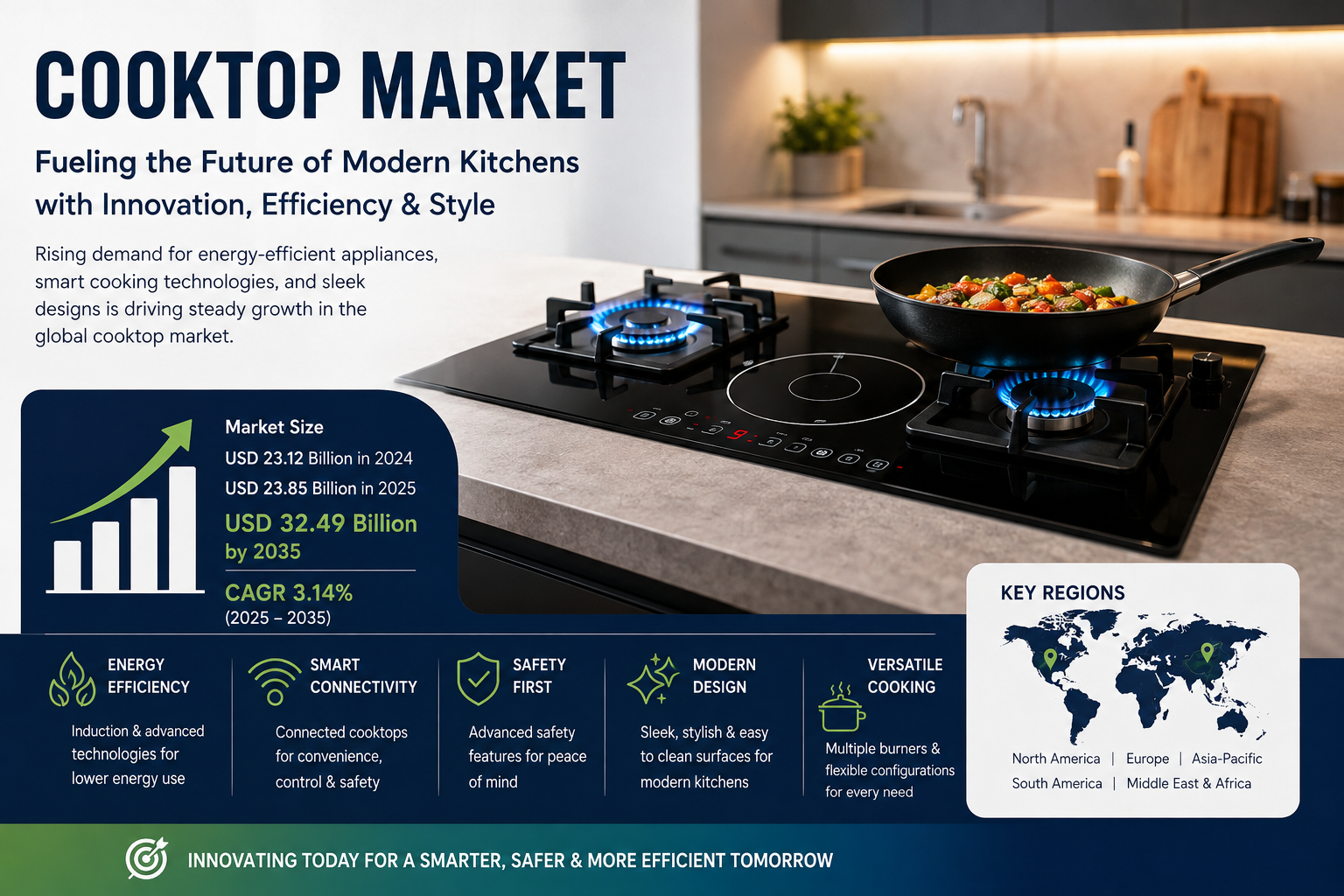
Cooktop Market
Induction adoption, connected appliances, sustainable designs, and expanding residential demand are expected to support steady growth through 2035.
Innovation in energy efficiency, smart connectivity, and modern kitchen design is creating new opportunities for cooktop manufacturers worldwide.”
NEW YORK, NY, UNITED STATES, August 31, 2026 /EINPresswire.com/ -- The global Cooktop Market is entering a period of steady transformation as consumers, hospitality businesses, and kitchen designers increasingly prioritize energy efficiency, convenience, advanced cooking performance, and modern aesthetics. According to Market Research Future analysis, the Cooktop Market was estimated at USD 23.12 billion in 2024 and is projected to increase from USD 23.85 billion in 2025 to USD 32.49 billion by 2035, representing a compound annual growth rate (CAGR) of 3.14% during the forecast period from 2025 to 2035.— Market Research Future (MRFR)
The expansion reflects a broader evolution in kitchen appliances, where traditional cooking functionality is increasingly combined with energy-conscious operation, connected technology, flexible configurations, and contemporary design. Cooktops have become an important component of modern residential and commercial kitchens, with manufacturers developing products that address changing consumer expectations around cooking speed, safety, ease of cleaning, temperature control, and integration with smart-home ecosystems.
Market Overview: Steady Expansion Supported by Kitchen Modernization
The cooktop industry occupies an important position within the broader household and commercial appliance ecosystem. Demand is influenced by residential construction, kitchen renovations, urbanization, replacement cycles, disposable income, changing cooking habits, and technological innovation.
According to Market Research Future, the industry is expected to advance from USD 23.85 billion in 2025 to USD 32.49 billion by 2035. The projected 3.14% CAGR indicates a sustained expansion trajectory rather than a short-term surge.
One of the most significant changes shaping the sector is the movement toward energy-efficient cooking technologies. Consumers are increasingly examining appliance performance not only in terms of cooking capability but also in terms of energy consumption, safety, durability, and long-term household operating costs.
This trend is particularly relevant to induction cooktops, which use electromagnetic technology to heat compatible cookware directly. The technology offers rapid heating, precise control, and reduced residual heat, making induction an increasingly attractive option for consumers seeking modern cooking experiences.
At the same time, gas cooktops continue to hold an important position because of their established consumer familiarity, immediate heat response, and strong appeal among consumers who prefer conventional cooking methods.
Electric and hybrid configurations are also contributing to product diversity, allowing manufacturers to target different household requirements, kitchen layouts, price points, and cooking preferences.
Get Full PDF Sample Copy of Report: (Including Full TOC, List of Tables & Figures, Chart) @ https://www.marketresearchfuture.com/sample_request/38750
Smart Technology Is Reshaping the Modern Cooktop
The integration of smart technology represents one of the most important developments influencing the future of cooktops.
Connected cooktops can incorporate features such as digital controls, temperature monitoring, remote operation, automated settings, timers, cooking alerts, and compatibility with broader smart-home systems. These capabilities are designed to improve convenience while giving consumers greater control over cooking activities.
The rise of connected-home ecosystems is encouraging appliance manufacturers to move beyond conventional hardware and develop products that communicate with other household devices. Consumers increasingly expect kitchen appliances to provide intuitive interfaces and seamless integration with their digital lifestyles.
Smart functionality can also support safety and operational efficiency. Features such as automatic shutoff, overheating protection, child-lock systems, and digital monitoring can provide additional layers of convenience for households.
As connected-home adoption continues to expand, manufacturers have opportunities to differentiate products through software-enabled features, app connectivity, voice control, intelligent cooking assistance, and personalized user experiences.
Energy Efficiency and Induction Adoption Create New Opportunities
Energy efficiency has become a central consideration in appliance purchasing decisions. Consumers and businesses are increasingly interested in technologies that deliver strong performance while reducing unnecessary energy use.
Induction cooktops are particularly well positioned within this transition. Their direct heating mechanism can provide rapid cooking and precise temperature management, while the cooking surface generally remains cooler than conventional heating technologies after use.
Market Research Future identifies increasing demand for induction cooktops as an important driver of industry development.
The growing popularity of induction cooking is also supported by changing kitchen aesthetics. Sleek glass surfaces and minimalist controls can complement contemporary kitchen designs, making induction cooktops attractive not only for functional reasons but also as design elements.
Manufacturers are therefore focusing on combining energy efficiency with premium styling, intuitive interfaces, compact configurations, and advanced safety features.
Changing Consumer Preferences Encourage Product Innovation
Consumer expectations for kitchen appliances have evolved significantly. Modern buyers increasingly seek appliances that combine performance, convenience, appearance, safety, and technology in a single product.
This has encouraged manufacturers to expand their product portfolios across gas, electric, induction, and hybrid cooktops. Different configurations allow companies to address diverse culinary traditions and household preferences across global markets.
The demand for versatile cooking solutions is particularly relevant in urban environments, where kitchen space can be limited. Compact and multifunctional cooktops can help consumers maximize available counter space while maintaining multiple cooking capabilities.
Manufacturers are also paying greater attention to materials and surface finishes. Stainless steel remains widely used because of its durability and established appeal, while ceramic glass surfaces are gaining traction because they provide a sleek appearance and can support modern kitchen aesthetics.
The increasing use of advanced materials can also help manufacturers improve durability, cleaning convenience, thermal performance, and overall product design.
Market Segmentation Highlights Diverse Demand
Market Research Future segments the Cooktop Market according to cooktop type, material, number of burners, end use, and region.
By cooktop type, the industry includes gas cooktops, electric cooktops, induction cooktops, and hybrid cooktops. Gas cooktops remain an important segment, supported by their established presence and consumer familiarity. Meanwhile, induction cooktops are gaining attention because of their efficiency, safety, and rapid heating capabilities.
By material, the industry encompasses stainless steel, ceramic glass, cast iron, and aluminum. Material selection influences product durability, appearance, heat management, maintenance requirements, and manufacturing costs.
By number of burners, products are categorized into single-burner, double-burner, triple-burner, four-burner, and five-burner configurations. Burner configuration enables manufacturers to address everything from compact residential kitchens to larger household and commercial cooking requirements.
By end use, the industry includes residential, commercial, and industrial applications. Residential applications represent a major source of demand, supported by new housing, remodeling activity, replacement purchases, and growing consumer interest in upgraded kitchens.
Commercial applications are also important, particularly across restaurants, hospitality establishments, catering operations, and other food-service environments where durability, high output, and reliable temperature control are essential.
Regional Outlook: North America Leads While Asia-Pacific Gains Momentum
Regional dynamics are expected to play a significant role in the development of the global cooktop industry.
North America remains a major market, supported by established appliance manufacturers, high consumer spending capacity, smart-home adoption, kitchen remodeling activity, and demand for technologically advanced appliances. The region's consumers also show strong interest in premium kitchen products that combine design and functionality.
Europe represents another important market, with sustainability, energy efficiency, product design, and regulatory considerations influencing consumer and manufacturer decisions. The region has a strong market for premium appliances and advanced cooking technologies, including induction solutions.
Asia-Pacific is positioned as a significant growth opportunity. Rapid urbanization, increasing household incomes, modernization of residential kitchens, and growing awareness of advanced cooking technologies are supporting demand. China and India are particularly important markets within the region, while manufacturers are increasingly developing products tailored to local cooking practices and price sensitivities.
The Middle East and Africa region presents emerging opportunities as urbanization and modern residential development increase demand for contemporary kitchen appliances. Growing consumer interest in premium kitchen designs and technologically advanced products could further support adoption.
South America also offers opportunities associated with residential development, appliance replacement, urbanization, and changing household preferences.
E-Commerce Expands Consumer Access
The expansion of online retail is changing how consumers discover, compare, and purchase kitchen appliances.
E-commerce platforms allow buyers to compare specifications, prices, features, customer reviews, dimensions, energy characteristics, and product designs before making purchasing decisions. This increased transparency can benefit manufacturers that offer differentiated products with strong digital visibility.
Online channels can also help manufacturers and retailers reach consumers beyond traditional physical appliance stores. Detailed product demonstrations, instructional videos, virtual consultations, and digital advertising are becoming increasingly important components of the appliance purchasing journey.
For cooktop manufacturers, digital commerce creates opportunities to introduce products directly to consumers while gathering insights into purchasing behavior and product preferences.
Competitive Landscape
The global Cooktop Market is competitive, with established appliance manufacturers and technology-focused brands investing in product development, energy efficiency, smart connectivity, design, and geographic expansion.
Key companies identified by Market Research Future include Whirlpool, Bosch, Samsung, LG Electronics, GE Appliances, Miele, Electrolux, Frigidaire, and Fisher & Paykel.
Competition is increasingly shifting from basic cooking performance toward broader product ecosystems. Manufacturers are seeking differentiation through connected features, intuitive interfaces, premium materials, energy-conscious designs, safety functions, flexible cooking zones, and integration with smart-home platforms.
Product innovation is expected to remain a major competitive strategy as manufacturers attempt to capture consumers upgrading from conventional appliances.
Companies that successfully combine reliable cooking performance with energy efficiency, intelligent features, attractive design, and competitive pricing could be well positioned to benefit from the industry's long-term expansion.
Sustainability Becomes an Increasingly Important Product Attribute
Environmental considerations are becoming increasingly relevant across the appliance industry.
Consumers are paying greater attention to energy consumption, product durability, material selection, and overall environmental impact. Manufacturers are consequently exploring ways to improve the efficiency of appliances while reducing resource use during production and extending product life.
For cooktops, energy-efficient technologies can serve as an important differentiating factor. Induction systems, in particular, align with consumer interest in efficient cooking and precise energy delivery.
Sustainability is also influencing product materials and manufacturing strategies. As environmental awareness increases, companies may place greater emphasis on recyclable materials, efficient manufacturing processes, longer product lifecycles, and responsible supply-chain practices.
Future Outlook: Smart, Efficient and Flexible Cooking Solutions
The Cooktop Market is expected to maintain steady growth through 2035, with Market Research Future projecting a rise to USD 32.49 billion by 2035 at a CAGR of 3.14% from 2025 to 2035.
Several opportunities are expected to influence the industry's future direction. Smart connectivity can create new avenues for product differentiation, while induction technology can benefit from increasing consumer attention to efficiency and safety.
Manufacturers may also find opportunities by developing compact appliances for urban households, premium products for kitchen renovation projects, versatile hybrid systems, and connected appliances designed to work within broader smart-home environments.
The commercial segment could provide additional growth opportunities as restaurants, hotels, catering businesses, and other food-service operators seek reliable cooking equipment capable of supporting demanding operating environments.
Meanwhile, emerging economies offer manufacturers opportunities to expand their geographic presence through locally relevant product designs, accessible pricing, distribution partnerships, and digital retail channels.
Overall, the future of the cooktop industry is likely to be defined by the convergence of technology, efficiency, design, convenience, and sustainability. As consumers increasingly view kitchen appliances as integrated components of modern homes rather than standalone products, manufacturers will have opportunities to build differentiated offerings around connected cooking, intelligent controls, energy-conscious operation, and flexible kitchen design.
Discover Related Research Reports By Market Research Future:
Residential Induction Cooktop Market
https://www.marketresearchfuture.com/reports/residential-induction-cooktop-market-41404
Smart Cooker Market
https://www.marketresearchfuture.com/reports/smart-cooker-market-41850
Enameled Cookware Market
https://www.marketresearchfuture.com/reports/enameled-cookware-market-12465
Market Research Future
Market Research Future
+1 855-661-4441
email us here
Legal Disclaimer:
EIN Presswire provides this news content "as is" without warranty of any kind. We do not accept any responsibility or liability for the accuracy, content, images, videos, licenses, completeness, legality, or reliability of the information contained in this article. If you have any complaints or copyright issues related to this article, kindly contact the author above.
